Two identical roofs, same shingles, same street in Overland Park. A single crew laid both the same week. One lasts twenty-two years. However, the other starts failing at fourteen.
The difference usually isn’t the roof. Instead, it’s the air underneath it.
Attic ventilation is the least visible part of a roofing system and the most common reason a roof in Kansas City never reaches the life the manufacturer promised. In fact, manufacturers know this so well that inadequate ventilation voids most shingle warranties outright.
What ventilation actually does
A roof system needs continuous airflow: cool outside air entering low at the soffits, warm air exiting high at the ridge. That movement does two jobs, and both matter here.
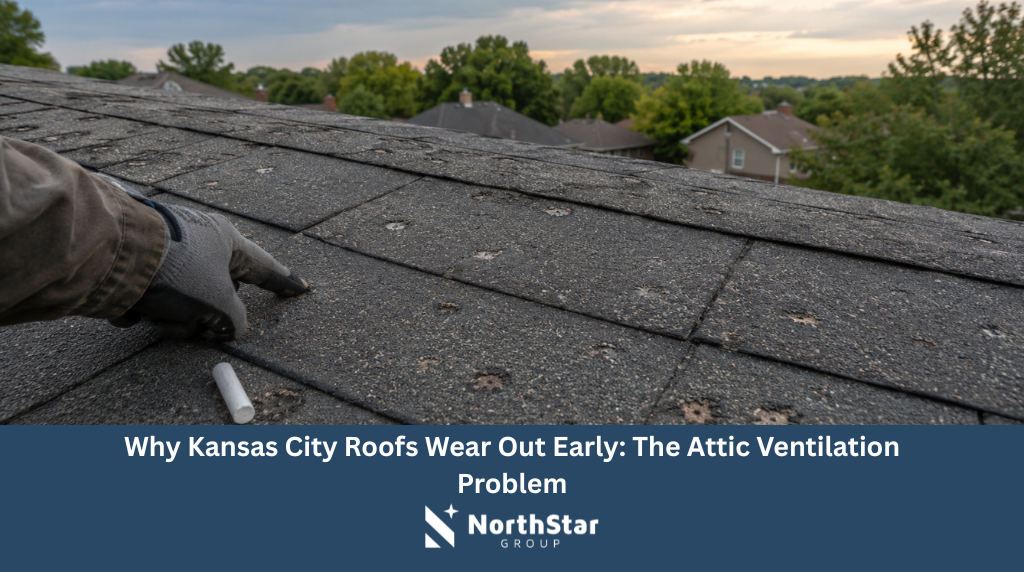
In summer, an unventilated attic in this metro can reach 150°F. Asphalt shingles are a petroleum product, so sustained heat from below drives out the volatile oils that keep them flexible. As a result, they turn brittle, they curl, they shed granules. The roof ages from the inside.
In winter, the problem reverses. Warm moist air from the house rises into the attic and condenses on the cold underside of the decking. Over a few seasons that produces damp sheathing, compressed insulation, and mold — and none of it shows until someone goes up with a flashlight.
The ice dam problem specific to this climate
Kansas City gets the freeze-thaw cycle that creates ice dams. Therefore ventilation matters more here than it does in milder markets.
Here’s the mechanism. First, heat escaping into the attic warms the roof deck. Then snow on the roof melts from below and runs down to the eave, which stays colder because it overhangs unheated space. There it refreezes. That ridge of ice grows, and meltwater backs up behind it, under the shingles, into the house.
Shingles shed water. However, they do not hold back standing water. That’s why ice dams damage interiors on roofs that are otherwise in perfect condition.
A properly ventilated attic stays close to outside temperature, so the snow melts evenly or not at all.
How to check yours
Go into the attic on a hot afternoon. If it feels dramatically hotter than outside and the air sits still, you have a problem.
Then look at the soffits from the ground. Vented soffit panels show visible perforations. If yours look solid, or if a siding crew covered them, the intake side is dead — and above all, people forget the intake side.
From inside the attic, check whether insulation buried the soffit openings. This happens constantly, and it blocks airflow completely. Baffles prevent it, so ask whether yours has any.
Also look for rusted nail tips on the underside of the decking, dark staining, or insulation lying flat and compressed. All three point to condensation.
Finally, count your exhaust. A ridge vent should run most of the ridge, not three feet in the middle.
The balance rule
Intake and exhaust have to match, and this is where most systems fail.
If your roof has more exhaust than intake, the vents pull air from inside the house instead of from outside. As a result, you vent conditioned air into the attic, raise your energy bill, and do nothing for the roof.
Mixing exhaust types causes the same problem. A ridge vent working alongside powered attic fans or box vents lets the fan draw air from the nearest ridge opening rather than from the soffits, which short-circuits the whole system. In short, pick one exhaust method and commit to it.
Why this matters before you replace
Understand this now, because ventilation costs almost nothing to correct during a roof replacement and a great deal afterward.
If a contractor quotes you a replacement without inspecting the attic, without discussing intake, and without asking about ice damming history, they’re quoting shingles — not a roof system. Those are different products at the same price.
So ask any roofer you’re considering: what’s my current net free vent area, what does it need to reach, and how do you get there? A good answer includes numbers. A vague answer tells you what you needed to know.
The roof that fails at fourteen years — nobody installed it badly. A crew laid it over a problem nobody looked at.
NorthStar Group inspects attic ventilation as part of every roof evaluation in the Kansas City metro. Schedule a free inspection below.